When the Global Crisis Hits Your Workforce
From US tariffs to subsidy cuts, Malaysia’s cost-of-living crisis has become a boardroom performance crisis — and it’s already inside your organisation. Here is what the data demands CHROs and HR leaders do now.
The global crisis is no longer an abstraction on a news ticker. It has walked through your office door, taken a seat in your meetings, and is quietly degrading the output of your most committed employees. Financial stress in Malaysia has reached a convergence point — subsidy cuts, a weakening ringgit, a US–China trade war that has placed a 24% tariff on Malaysian exports, and a cost of living that has outpaced what most households planned for. For CHROs and HR leaders, the question is no longer whether this is happening. The question is: are you measuring what it is costing your organisation?
The Context: A Perfect Storm for Malaysian Workers
Malaysia is navigating one of the most financially demanding periods for households in recent memory. The rationalisation of diesel subsidies in 2024, ongoing pressure on RON95 pricing, and cascading effects on food, utilities, and transportation have pushed the cost of living well beyond what millions of employees anticipated. The Ministry of Finance projected inflation of between 2% and 3.5% for 2025 — modest on paper, but felt acutely by households already stretched across rent, school fees, car loans, and daily essentials.
Now layer a global crisis on top. The US imposed sweeping reciprocal tariffs in April 2025, with Malaysia absorbing a 24% rate — among the heaviest in Southeast Asia. Industries from electronics to palm oil and furniture, which collectively employ hundreds of thousands of Malaysian workers, are now navigating an export environment that has fundamentally shifted. For employees in these sectors, that macro uncertainty translates immediately into personal financial anxiety: Will my role still exist? Will my salary still stretch? What happens if another shock hits before I have any buffer?
GLOBAL CRISIS IMPACT — MALAYSIA 2026
The Global Trade War Has Arrived at Your Office Door
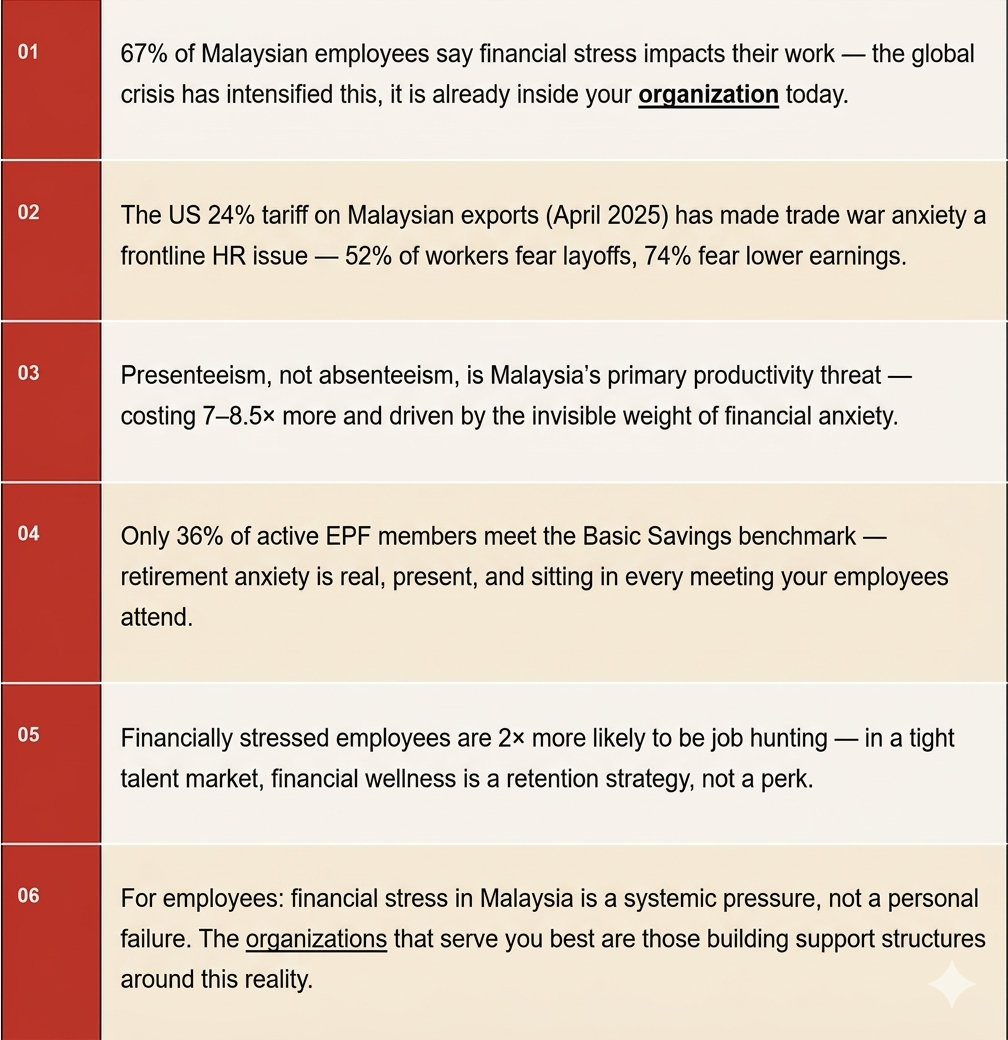
A survey of 5,000 frontline workers found that 52% now fear tariffs will lead to layoffs, while 74% believe these trade policies will directly impact their future earnings. Among Gen Z workers, 3 in 5 fear job loss — making financial anxiety a generational crisis, not just an economic one. When your workforce is watching global headlines and silently calculating what it means for their job security, that cognitive weight appears directly in your productivity and engagement data.
The Data: What Financial Stress in Malaysia Is Costing Employers
Before this becomes a conversation about employee benefits programmes, it needs to be a conversation about numbers. Because the financial stress Malaysia’s workforce is carrying right now is not a soft HR issue- it is a measurable performance problem with a quantifiable cost.
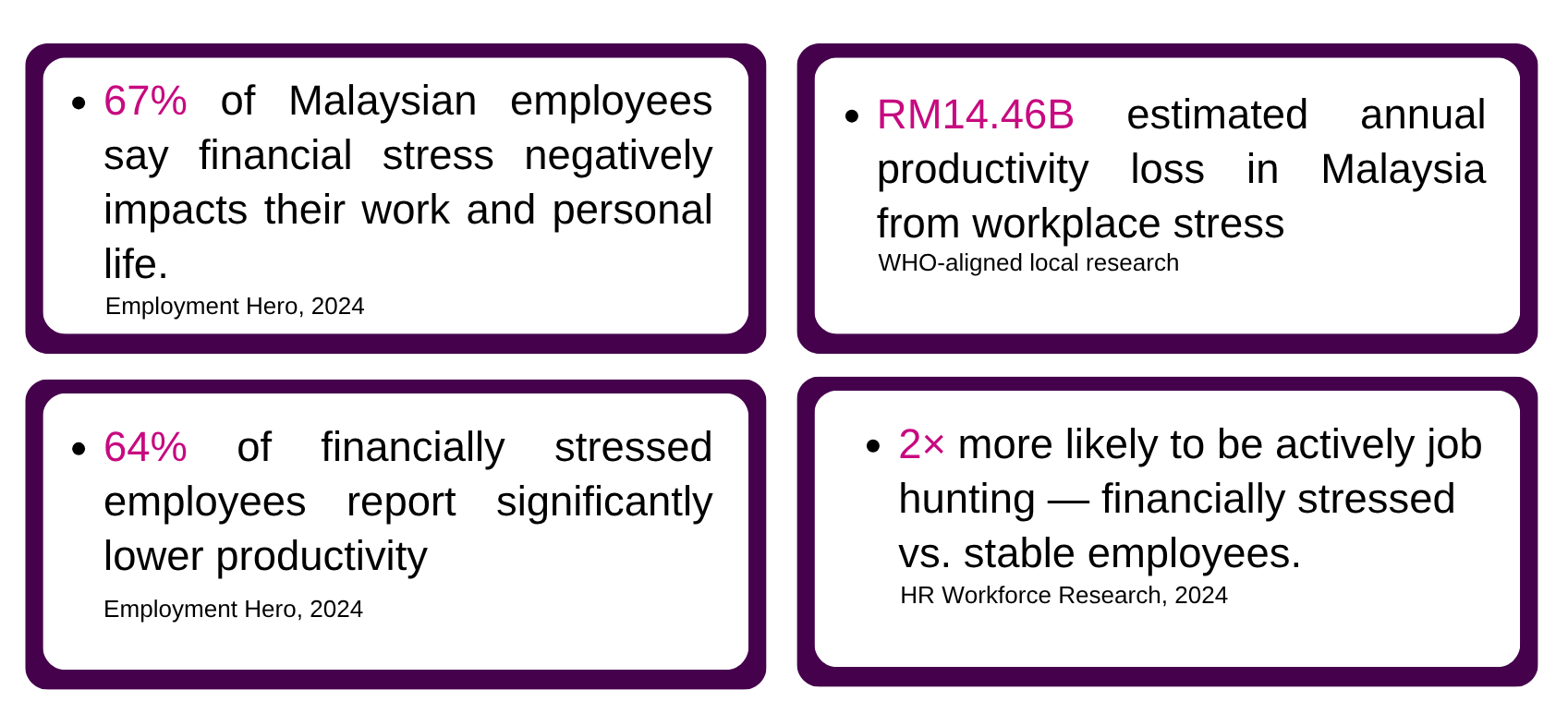
These figures are not abstract. They represent real people inside your teams- present physically, but absent mentally- not because they lack commitment, but because the cognitive weight of financial anxiety is relentless and measurable. Two employees, same role, same team: one is quietly managing a debt spiral, an overdue bill, or an EPF statement that keeps them awake at night. The financially stressed one is operating at a measurable disadvantage, and so is every deliverable they touch.
“Financially stressed employees are only half as likely to feel energised in their work compared to those who are financially stable. That gap- 18 percentage points in engagement – translates directly into output quality, collaboration, and retention.” — HR Workforce Research, Malaysia 2024
Why This Is an Organisational Issue, Not a Personal One
For years, Malaysian workplace culture upheld the expectation that financial matters were personal. Employees were expected to compartmentalise. That expectation is now untenable not because the culture has changed, but because the data has made it indefensible.
The neuroscience is unambiguous: financial stress activates the same threat-response pathways as physical danger. Under that cognitive load, complex problem-solving, creativity, and sound decision-making are all measurably impaired. No performance management framework, no KPI structure, and no training programme will fix what is fundamentally a financial well-being deficit. You cannot performance-manage your way out of a systemic cost-of-living crisis.
For individual employees reading this: if you recognise yourself in these descriptions, you are not alone and you are not failing. Financial stress in Malaysia today is a systemic pressure- amplified by global trade disruption, policy shifts, and structural gaps in the financial safety net -not a reflection of your discipline or character.
The Productivity Drain CHROs Can Quantify — and Must Report
Here is the number worth bringing to your next leadership meeting: Malaysian research indicates that workplace stress results in the equivalent of 73.3 lost productive days per employee per year. For a workforce of 200 employees, that is over 14,000 days of productive capacity disappearing annually — not from disengagement or poor culture, but from the invisible tax of financial anxiety.
The bigger threat in Malaysia is not absenteeism, however. It is presenteeism. AIA Vitality research found that presenteeism generates 7 to 8.5 times more productivity loss than absenteeism in the Malaysian context. Employees show up. They attend meetings. They respond to messages. But their minds are running through repayment schedules, calculating whether this month’s salary will stretch far enough, or quietly catastrophising about the financial emergency they have no buffer to absorb.
In the context of a global trade crisis that has directly raised the financial anxiety of Malaysian workers across industries, this presenteeism cost is not static. It is compounding. Every new tariff headline, every fuel price adjustment, every month where the EPF statement falls short of the benchmark — these events do not stay outside the office. They come in with your employees every single morning.
The EPF Reality Every HR Leader in Malaysia Should Know
One data point must anchor every CHRO’s financial wellness strategy in Malaysia: only 36% of active EPF members currently meet the Basic Savings benchmark for their age group. The majority of Malaysia’s workforce is heading toward retirement with a meaningful savings shortfall — a slow-building crisis that generates real, present financial anxiety for employees in their 30s, 40s, and 50s right now.
The three-account EPF restructuring introduced in 2024 has added another layer of complexity and concern for members still navigating what it means for their financial future. When employees are uncertain whether they will have enough to retire on, that uncertainty does not stay at home. It occupies every meeting, every project, every strategic decision they are asked to make. HR leaders who understand the EPF savings reality in Malaysia — and who build support structures that address it — are not offering a perk. They are protecting their organisation’s most critical asset: cognitive capacity at work.
What HR Leaders Must Do Differently in a Global Crisis Context
The standard wellness programme — a mental health app, an EAP hotline, a financial literacy webinar once a year — was never sufficient. In a year when Malaysian workers are absorbing global trade shocks, domestic subsidy rationalisation, and a retirement savings gap simultaneously, the bar is considerably higher.
- Transparent Communication Comes First
HR departments must prioritise direct, honest communication about how global economic shifts — including the 2025 US tariff regime — may affect operations, headcount, and compensation. Employees who are left to interpret macro headlines through the lens of their own anxiety will almost always arrive at the worst-case scenario. Leadership that gets ahead of that narrative, with facts and a clear plan, does not eliminate financial stress — but it removes the amplifying effect of uncertainty.
- Bring Financial Professionals In
EPF planning sessions, debt management workshops, and personalised financial coaching are not expensive add-ons. They are a direct investment in cognitive availability. Every employee who leaves a financial planning session with a clearer picture of their position is an employee whose mental bandwidth returns to the work in front of them.
- Measure the Right Thing
Most organisations in Malaysia are measuring absenteeism. The data is clear that presenteeism is 7 to 8.5 times more costly. If your current HR analytics framework does not have a mechanism to detect presenteeism — through pulse surveys, productivity pattern analysis, or manager feedback — you are measuring the smaller problem and missing the larger one.
If you would like to understand how employee financial stress in Malaysia is affecting your organisation’s productivity, engagement, and retention, we would be happy to have a conversation.
Our Financial Literacy for Employees programmes are designed to build resilience, clarity, and long-term financial stability across your workforce.
Connect with us to explore a structured approach.